


Category
- Labels sheets
- FSC-certified sheets
- Labels on rolls for printers
- Ink-Jet labels for EPSON ColorWorks
- ADR Danger Labels
- GHS Signs
- Information labels
- Transparent sealing circles for packaging
- Colored markings
- Promotional and Discount Labels
Last viewed
Showing all 9 results
-

15 in stock*
Label GHS01 100x100mm — Explosion hazard
GHS01 — Explosion hazard. Self-adhesive 100x100mm PP label with laminate. Choose 10 labels or 450 labels per roll. Select the pictogram according ...
From €3.72 Add do cart This product has multiple variants. The options may be chosen on the product page -

36 in stock*
Label GHS02 100x100mm — Fire hazard
GHS02 — Fire hazard. Self-adhesive 100x100mm PP label with laminate. Choose 10 labels or 450 labels per roll. Select the pictogram according ...
From €3.72 Add do cart This product has multiple variants. The options may be chosen on the product page -

47 in stock*
Label GHS03 100x100mm — Oxidising properties
GHS03 — Oxidising properties. Self-adhesive 100x100mm PP label with laminate. Choose 10 labels or 450 labels per roll. Select the pictogram according ...
From €3.72 Add do cart This product has multiple variants. The options may be chosen on the product page -

20 in stock*
Label GHS04 100x100mm — Gases under pressure
GHS04 — Gases under pressure. Self-adhesive 100x100mm PP label with laminate. Choose 10 labels or 450 labels per roll. Select the pictogram ...
From €3.72 Add do cart This product has multiple variants. The options may be chosen on the product page -

24 in stock*
Label GHS05 100x100mm — Corrosive effects
GHS05 — Corrosive effects. Self-adhesive 100x100mm PP label with laminate. Choose 10 labels or 450 labels per roll. Select the pictogram according ...
From €3.72 Add do cart This product has multiple variants. The options may be chosen on the product page -

12 in stock*
Label GHS06 100x100mm — Acute toxicity
GHS06 — Acute toxicity. Self-adhesive 100x100mm PP label with laminate. Choose 10 labels or 450 labels per roll. Select the pictogram according ...
From €3.72 Add do cart This product has multiple variants. The options may be chosen on the product page -

37 in stock*
Label GHS07 100x100mm — Harmful or irritant effects
GHS07 — Harmful or irritant effects. Self-adhesive 100x100mm PP label with laminate. Choose 10 labels or 450 labels per roll. Select the ...
From €3.72 Add do cart This product has multiple variants. The options may be chosen on the product page -
30 in stock*
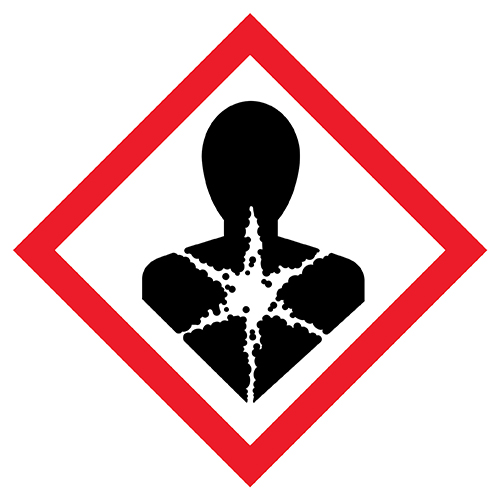
Label GHS08 100x100mm — Serious health hazard
GHS08 — Serious health hazard. Self-adhesive 100x100mm PP label with laminate. Choose 10 labels or 450 labels per roll. Select the pictogram ...
From €3.72 Add do cart This product has multiple variants. The options may be chosen on the product page -

26 in stock*
Label GHS09 100x100mm — Hazardous to the aquatic environment
GHS09 — Hazardous to the aquatic environment. Self-adhesive 100x100mm PP label with laminate. Choose 10 labels or 450 labels per roll. Select ...
From €3.72 Add do cart This product has multiple variants. The options may be chosen on the product page
Last viewed

GHS labels — pictograms for chemical labelling
Our range includes all nine GHS01–GHS09 pictograms in 100x100mm format, made from self-adhesive laminated polypropylene film. Choose the symbol to match the chemical product’s classification and the pack size to suit the number of containers you need to label. The range covers physical hazards, health hazards and selected environmental hazards; the symbols are not interchangeable.
GHS and CLP — what do they mean?
GHS is the United Nations’ Globally Harmonized System of Classification and Labelling of Chemicals. In the European Union, these principles are implemented through CLP. The familiar pictogram has a black symbol on a white background within a red diamond-shaped frame. Its GHS code identifies the design for ordering, while the relevant hazard classes and categories determine its meaning and use.
Nine pictograms — choose the appropriate hazard marking
- GHS01 — Explosion hazard: GHS01 shows an exploding bomb. It applies, among other cases, to unstable explosives, explosives of specified divisions, and type A or B self-reactive substances and mixtures and organic peroxides. The assigned classification determines its use; the general description ‘dangerous’ is not enough.
- GHS02 — Fire hazard: GHS02 shows a flame. It covers flammable gases, aerosols, liquids and solids in the relevant categories, as well as certain self-reactive, pyrophoric and self-heating materials, substances releasing flammable gas on contact with water and organic peroxides. The precise class and category determine the required labelling.
- GHS03 — Oxidising properties: GHS03 shows a flame over a circle. It applies to oxidising gases, liquids and solids in the relevant CLP categories. Such products may cause or intensify a fire and, in certain cases, contribute to an explosion. They do not have to be flammable themselves.
- GHS04 — Gases under pressure: GHS04 shows a gas cylinder and applies to compressed, liquefied, refrigerated liquefied and dissolved gases. Depending on the gas, the hazard may concern container pressure and heating, or the very low temperature of a refrigerated gas.
- GHS05 — Corrosive effects: GHS05 depicts liquid affecting a hand and a metal surface. It covers skin corrosion, serious eye damage and corrosion to metals in the relevant CLP categories. A product carrying the symbol does not necessarily have all these properties at once; its hazard statements provide the detail.
- GHS06 — Acute toxicity: GHS06 shows a skull and crossbones and identifies acute toxicity in categories 1, 2 and 3. It may relate to ingestion, skin contact or inhalation, according to the product’s classification. It is not a general symbol for every adverse health effect.
- GHS07 — Harmful or irritant effects: GHS07 shows an exclamation mark. It may indicate acute toxicity category 4, skin or eye irritation, or skin sensitisation. It also covers certain effects of single exposure, including respiratory irritation and narcotic effects, and hazards to the ozone layer.
- GHS08 — Serious health hazard: GHS08 shows a human silhouette with a mark on the chest. Its scope includes carcinogenicity, germ cell mutagenicity, reproductive toxicity, respiratory sensitisation, certain target-organ effects and aspiration hazard. Use depends on the relevant hazard class and category.
- GHS09 — Hazardous to the aquatic environment: GHS09 shows a dead fish and a tree. Under CLP it applies to aquatic acute category 1 and aquatic chronic categories 1 and 2. It is not required for every category of aquatic hazard, so a general statement that a product may harm the environment is insufficient for selection.
How to choose a pictogram for a substance or mixture
Start with the product’s current classification. Do not choose a symbol solely from a trade name, smell, colour or the description ‘industrial chemical’. Products with similar uses can have different formulations and different label requirements. Where several hazards apply, use the pictogram precedence rules: for example, GHS06 excludes GHS07, while GHS05 can exclude the exclamation mark for skin or eye irritation. Do not simply apply every symbol that seems relevant.
In the European Union, labelling is based on Regulation (EC) No 1272/2008 (CLP). Check the product’s current classification and the label elements in Section 2 of its safety data sheet, where one is required. Also consider the rules of precedence for pictograms.
A pictogram is not a complete chemical label
A sticker bearing only a symbol is not a complete chemical label. Depending on the product, other required elements include its identifier, supplier details, a signal word, hazard and precautionary statements and supplementary information. CLP pictograms and ADR transport labels serve different purposes and should not be treated as interchangeable.
Laminated PP film for packaging identification
The label is made from polypropylene film with an additional polypropylene laminate. The laminate covers the print and is a practical option for packaging used in industrial environments. The self-adhesive construction makes it easy to apply a ready-printed pictogram by hand.
Before using the label on a particular plastic, curved surface or packaging exposed to chemicals, test adhesion and durability under the intended conditions. Resistance depends on the substance involved, contact time and working environment. A laminate should not be assumed to provide equal protection against every solvent or cleaning agent.
100x100mm format — visibility and space on the container
All nine designs in this group have the commercial size 100x100mm. Compare this with the available surface, its curvature and the space needed for other information. The label should adhere properly and remain legible during normal use of the packaging.
Choose the marking size to suit the package and the complete label layout. The advertised sticker size is not automatically the size of the pictogram field, nor confirmation of suitability for every packaging capacity. Assess legibility and the relevant CLP requirements for the intended use.
10 labels or 450 labels per roll?
The product measures 100x100mm. Choose between 10 labels and 450 labels per roll. A smaller pack suits short labelling runs; a roll is convenient where labels are used regularly. Check the selected variant, price and stock availability before ordering.
Plan quantities for each symbol separately. One chemical package can require several different pictograms, and individual symbols may be used at different rates. Keep the stock of labels appropriate to your production or laboratory workflow. Current prices and availability appear after selecting the variant on the product page.
Surface preparation and application
- Choose a position that keeps the complete pictogram and the other required information visible.
- Remove dust and dirt; prepare a dry surface using a method suitable for the substrate and workplace safety procedures.
- Apply without creases and press evenly, paying particular attention to the edges.
- Do not cover identification details, instructions or other mandatory markings.
- Check legibility and adhesion during use; replace damaged or unreadable labels.
GHS labels, ADR transport labels and workplace signs
CLP communicates chemical hazards, while ADR governs the road transport of dangerous goods. Similar artwork does not make their markings interchangeable. Check transport classification and the required markings on the relevant packaging layers separately; transport information is in Section 14 of the safety data sheet. GHS pictograms also do not replace all workplace warning, mandatory or prohibition signs.
European manufacturer of GHS labels
Print&Stick is a European manufacturer of self-adhesive labels. Our ready-printed pictograms support labelling in warehouses, production, laboratories and chemical distribution. For repeat orders, specify the symbol code, dimensions and quantity. For help selecting the material, describe the surface and operating conditions. Classification and the required label content remain the responsibility of the party responsible for the chemical product.
Sources of labelling information
Consult the current CLP requirements, including the provisions on label elements, pictograms and precedence, and Annexes I and V. Explanations are also available from the European Chemicals Agency (ECHA). These descriptions help compare symbols; they do not replace classification of the specific substance or mixture.
